The Plant
Why every leaf has a job
A premium cigar is a blend of leaves from different parts of the tobacco plant, each chosen for a purpose: strength, aroma, combustion, structure, appearance, sweetness, spice, or smoothness. The important leaf-position terms are usually Volado, Seco, Viso, Ligero, and sometimes Medio Tiempo. Countries and factories use slightly different naming, but the idea holds: the higher a leaf grows on the plant, the more sun, oil, thickness, strength and slow-burning character it tends to develop.
One distinction matters before we go deeper. Leaf position is where the leaf grew on the plant. Cigar role is how the leaf is used — wrapper, binder, or filler. The same farm grows tobacco that gets sorted later by size, elasticity, color, texture, vein structure, blemishes and fermentation result. Premium cigars are built from three parts: the filler forms the main blend, the binder holds it together, and the wrapper gives the cigar its outer look and a major part of its flavor.
The Plant
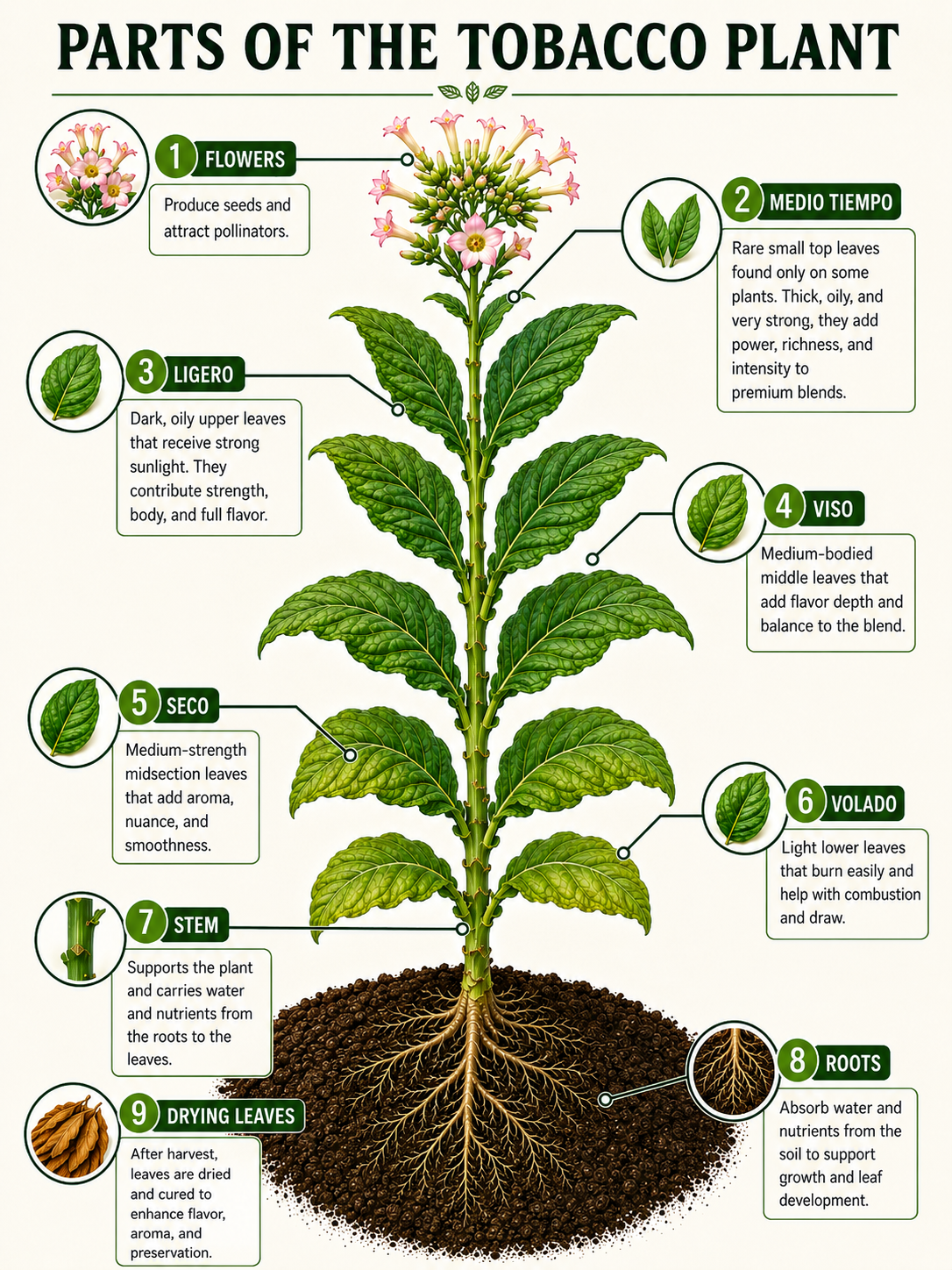
Parts of the tobacco plant, crown to root
Flowers
Seeds & PollinationAt the crown the plant flowers — pink-and-white blooms that make seed and draw pollinators. But on tobacco grown for cigar leaf, those flowers are usually topped (pinched off) early, so the plant pours its energy down into the leaves instead of into making seed. Only plants kept for seed are left to bloom.
Medio Tiempo
The Rare Crown LeafSmall, rare leaves that appear at the very crown of some plants — not every plant produces them. When used, they add power, richness and intensity, and are prized in high-end Cuban-style blending. The simple version: Medio Tiempo is like ultra-Ligero — rare, small, strong, and treasured when handled properly.
Ligero
The Power LeafUp top it catches the most sun, so it grows thick, dark, oily and powerful — body, spice, richness and a long finish. Because it burns slowly, it is usually tucked toward the center of the filler bunch; careless use makes a cigar burn unevenly. Strong cigars are not just “more Ligero” — they still need Volado, Seco or Viso to stay balanced. Ligero is the bass in the song: too little feels thin, too much turns heavy and muddy.
Viso
The Flavor BridgeViso sits between Seco and Ligero — more body and oil than Seco, but not as aggressive or slow-burning as Ligero. That makes it a bridge leaf: depth and balance while keeping the cigar smokeable. Good Viso brings notes smokers describe as cedar, earth, nuts, coffee, leather, baking spice or natural tobacco sweetness.
Seco
The Aroma & Balance LeafMilder than Viso and Ligero, Seco softens a blend and adds aroma without overpowering it. If Ligero is the muscle, Seco is the gentleman in the room — it keeps a cigar from turning too heavy, too spicy, or too sharp. Mild and medium cigars often lean on a higher share of Seco-style tobacco.
Volado
The Burn LeafVolado grows near the base, gets less sun, and stays thin, light and mild. It is not there to dominate flavor — it is the engine starter that keeps the cigar lit, drawing properly and burning evenly. A cigar made only of thick, oily, powerful leaf may taste bold but burn terribly; Volado balances that.
Stem
The BackboneThe central stalk holds the plant upright and carries water and nutrients up from the roots to every leaf. It is not smoked — but a healthy stem feeding the plant evenly is part of why the upper and lower leaves end up so different in strength and character.
Roots
The SourceBelow the soil the roots draw up water and nutrients to fuel growth and leaf development. The ground they reach into — its minerals, drainage and character — is a real part of why tobacco from one region, or even one field, can taste unlike another.
Drying Leaves
After the HarvestOnce primed, the leaves leave the plant and hang to dry and cure — shedding moisture and green chlorophyll as the color turns from green to yellow to brown. This is the first step that turns raw green leaf into tobacco that can develop flavor and aroma and keep. It is only the beginning, though: curing, then fermentation and aging, come next.
Construction
Wrapper, binder & filler
Every cigar has three construction roles. Get the leaf positions above into these three jobs and you understand how a cigar is built.
Filler
The inside blend, where Volado, Seco, Viso, Ligero and sometimes Medio Tiempo build the core personality — much of the strength, body, draw and how the flavor moves from light to finish.
Binder
Wraps around the filler and holds the bunch together. It gives structure and affects the burn. It need not be beautiful, but it must have strength, elasticity and reliability.
Wrapper
The outer leaf — the first thing you see and often a major flavor contributor. Chosen for appearance, elasticity, color, vein structure and aroma. It can add sweetness, spice, creaminess, earth, pepper, cocoa, cedar or floral notes.
Shade-grown wrapper is often grown under cloth to soften the sun and produce a thinner, smoother leaf; sun-grown wrapper is heartier and stronger in character. The wrapper is never just decoration — but it still needs filler and binder to support it.
Process
Harvesting in stages
Tobacco leaves do not all mature at once. The lower leaves ripen first, then the middle, then the upper. Many premium tobaccos are harvested by priming — workers pick leaves in stages from the bottom upward as each level reaches maturity, giving every priming its best moment.
There is also stalk-cut harvesting, where the whole plant is cut and cured with the stalk, which can influence curing. But the key idea for cigar lovers is simple: leaf position matters because each level of the plant has a different job.
Process
Curing: the first transformation
Fresh tobacco is green, wet, grassy and harsh — not ready to smoke. The first transformation is curing. Cigar tobacco is usually air-cured: leaves hang in barns where airflow, humidity and temperature are managed by opening and closing doors and vents. The leaf loses moisture, chlorophyll breaks down, and the color turns from green to yellow, brown or reddish-brown. Even after curing, the leaf is still raw — fermentation must still work out ammonia and impurities.
Not just drying
Curing is a controlled transformation, not simple dehydration. The leaf stays biologically active for part of it: chlorophyll degrades, starches turn toward sugars, proteins break down. Rushed curing leaves tobacco green, harsh or flat; too much humidity invites mold. Good curing preserves potential; bad curing destroys it before fermentation begins.
Different products use different methods — air-curing for cigar and burley tobaccos, flue-curing for cigarette-style Virginia, fire-curing with hardwood smoke, sun-curing for some Oriental leaf.
Process
Fermentation: raw leaf to cigar tobacco
Fermentation is the heart of premium cigar tobacco. In factories it is called sweating or working the tobacco. Leaves are moistened, gathered into bundles and stacked into piles called pilones (larger stacks are sometimes called burros). Under their own weight and controlled humidity, the tobacco naturally heats — and that heat is watched carefully.
The purpose is to drive off ammonia, remove harshness, reduce raw vegetal character, deepen color, improve aroma, improve combustion and smooth the smoke. This is why unfermented tobacco can smell sharp or chemical, while well-fermented tobacco smells rich, earthy, sweet, leathery and woody.
The basic cycle
- Cured leaves are sorted by priming, texture, color, size and quality.
- Leaves are re-humidified so they are pliable and active enough to ferment.
- They are stacked into pilones, where pressure, moisture and natural enzyme activity generate heat.
- The center temperature rises. Workers monitor the pile.
- The pile is opened and turned when it gets too hot or hits the factory’s target.
- Leaves are restacked — outer leaves move inward, inner leaves move outward.
- The cycle repeats until the tobacco stabilizes and the harsh ammonia character is gone.
- The tobacco is dried, packed and aged before final sorting, stripping and rolling.
A first fermentation often uses short pilones; a more intense second fermentation in large burros can run about 60 days or longer. Denser, more robust Ligero takes longer to process than Seco and Volado.
The dangerous line
Fermentation must be hot enough to transform the leaf, but not so hot it “burns out.” Overheat and the tobacco goes flat, scorched, bitter or fragile; too cool and it stays raw and ammonia-heavy. A common guideline keeps the center temperature from exceeding roughly 108–140°F, with piles opened and redistributed when they reach critical levels. Wrapper is treated more delicately than filler, since it must stay beautiful and elastic.
What it does to flavor
- Reduces ammonia and harshness — the biggest reason raw cured leaf is not ready.
- Deepens and evens out the color.
- Develops aroma, moving from green and sharp toward earth, cedar, hay, cocoa, coffee, leather, spice and dried fruit.
- Improves combustion, so the leaf burns more predictably.
- Softens the smoke — powerful tobacco becomes smokeable without losing its character.
Process
Curing, fermentation, aging
These are not the same thing. Fermentation is active — warm, moist, stacked, monitored and turned. Aging is gentler: once fermented and stabilized, tobacco may be packed into bales and aged for months or years, rounding the tobacco and marrying flavors. A cigar can also age after rolling, letting wrapper, binder and filler settle together.
Finishing
Maduro: a style, not a color
A common beginner mistake is thinking Maduro simply means dark tobacco. Maduro means “ripe,” but in cigar terms it usually refers to a wrapper taken through a longer, hotter fermentation and aging that darkens the leaf and brings out richer sweetness, oil and body — notes often described as chocolate, coffee, molasses or dried fruit.
But dark does not automatically mean strong. A Maduro wrapper can be sweet, smooth and rich without being the strongest cigar in the humidor. Strength depends on the whole blend — especially the filler.
Craft
What makes a wrapper leaf
Wrapper-grade leaf has to be both beautiful and functional. Not every good-tasting leaf can become wrapper — some taste great but are too rough, veiny, small, scarred, thick or uneven, and become binder or filler instead. A wrapper leaf needs:
- Good size and few blemishes
- Fine veins and even color
- Elasticity and smooth texture
- Proper oil and good aroma after fermentation
- Enough strength to wrap without tearing
This is why wrapper tobacco is expensive: it must survive growing, harvesting, curing, fermentation, sorting, handling and rolling while still looking good.
Craft
The blender’s mindset
A blender is not just choosing “good tobacco.” He is balancing jobs — and every excess has a cost:
- Too much Ligero: powerful, but slow-burning and possibly harsh.
- Too much Volado: burns well, but may taste thin.
- Too much Seco: aromatic and smooth, but may lack body.
- Too much Viso: flavorful, but may need support for burn or strength.
- Wrong wrapper: a beautiful cigar whose flavor clashes.
- Wrong binder: draw and burn problems.
A great cigar is a controlled argument between leaves. One brings fire, one brings perfume, one brings structure, one brings strength, one brings beauty. The blender’s job is to make them agree.
Reference
The cheat sheet
| Leaf | Where it grows | Main purpose | Smoking effect |
|---|---|---|---|
| Volado | Bottom | Burn | Helps the cigar stay lit |
| Seco | Lower / middle | Aroma & balance | Mild, fragrant, smoother |
| Viso | Middle / upper-middle | Flavor & body | Balanced, flavorful, medium strength |
| Ligero | Top | Strength & depth | Strong, oily, slow-burning |
| Medio Tiempo | Very top / crown | Rare intensity | Rich, powerful, limited-use leaf |
| Wrapper | Outer cigar leaf | Appearance & flavor accent | Major effect on first impression and taste |
| Binder | Around filler | Structure | Holds the cigar together, supports burn |
| Filler | Inside | Core blend | Determines strength, body, complexity |
In short
The simple version
The tobacco plant is a vertical flavor ladder.
At the bottom, the leaves are thinner and easier to burn. In the middle, they bring aroma and balance. Near the top, they grow thicker, oilier, stronger and slower-burning.
After harvest, curing turns green leaf into brown tobacco. Fermentation sweats out harshness and develops aroma. Aging polishes the result.
That is why two cigars can both be “premium” and smoke completely differently. The magic is not just the brand — it is the seed, soil, priming, curing, fermentation, aging, and the blender’s hand.
A note on health. Tobacco is addictive and harmful. The World Health Organization states there is no safe level of tobacco exposure, and lists cigars among tobacco products. Everything here is for education and enjoyment by those of legal smoking age.